

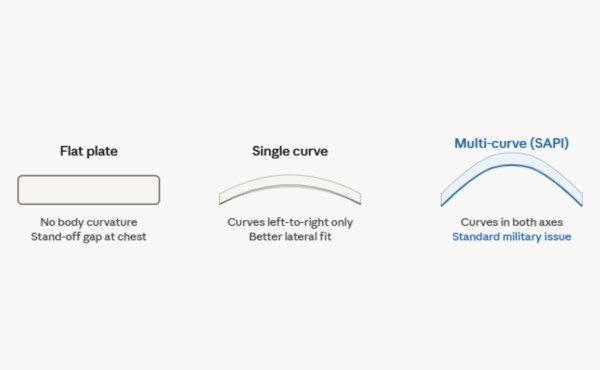
Modern military ballistic plates are curved — not flat. The standard U.S. Army issue plate, known as the ESAPI (Enhanced Small Arms Protective Insert), features a multi-curve profile that conforms to the natural contour of the human torso. Flat plates exist and are used in specific contexts, but they are not the military standard for frontline body armor
The Three Types of Plate Curvature
Understanding ballistic plate geometry starts with knowing the three profile categories used across military and law enforcement:
1. Flat Plates
Flat plates have zero curvature — they are completely planar. While they are the simplest and cheapest to manufacture, they do not conform to the human body. When worn in a plate carrier, a flat plate creates an air gap between the plate and the wearer’s chest. This gap can cause the plate to shift during movement, reduces stability, and may affect how the plate handles ballistic impact. Flat plates are typically found in budget-oriented civilian carriers or used as back plates in some configurations where cost is prioritized over ergonomics.
2. Single-Curve Plates
Single-curve plates arc in one direction — typically left to right across the chest. They follow the lateral curvature of the torso but do not account for the front-to-back (superior to inferior) curve of the body. They sit closer to the body than flat plates and offer better comfort during extended wear. Single-curve plates are more common in law enforcement vests and older military surplus configurations.
3. Multi-Curve Plates
Multi-curve plates — also called double-curve or SAPI-cut plates — contour in both axes: left-to-right and top-to-bottom. This design mimics the natural curvature of the human chest and back, allowing the plate to lie flush against the body across the entire surface. Multi-curve plates are what the U.S. Army, Marine Corps, and most NATO military forces use as their standard. The ESAPI (Enhanced Small Arms Protective Insert) and XSAPI (X-tier Small Arms Protective Insert) are both multi-curve plates.
Why the Military Chose Curved Plates
The shift from flat to curved plates was driven by several tactical and physiological factors:
Body conformance and retention: A plate that sits flush against the torso does not shift during running, climbing, or ground movements. Flat plates can migrate upward or laterally during dynamic activity, leaving protected zones exposed.
Weight distribution: Multi-curve geometry distributes the plate’s weight more evenly across the torso. This reduces pressure hotspots, particularly on the shoulders and lower ribs, making the armor more tolerable during long missions.
Reduced signature and mobility: A curved plate that hugs the body creates a lower profile under outer garments and does not create the “refrigerator door” silhouette associated with flat plates. Soldiers wearing multi-curve plates can move more naturally through confined spaces.
Ballistic performance: While the ballistic material itself — typically silicon carbide, boron carbide, or polyethylene composites — does the actual stopping, the curvature can influence how incoming projectiles interact with the plate surface. An angled or curved surface can contribute to slight obliquity effects on the projectile.
The SAPI / ESAPI Standard Explained
The U.S. military standardized body armor inserts through the SAPI (Small Arms Protective Insert) system, developed in the 1990s. SAPI plates are made from boron carbide ceramic backed by a Spectra Shield composite and are rated to defeat specific rifle threats (NIJ Level III and above). The ESAPI variant, introduced in the early 2000s following combat experience in Afghanistan and Iraq, upgraded the protection level and uses a multi-curve profile as standard.
SAPI plates come in five sizes — XS, S, M, L, and XL — all with the same distinctive shooter’s cut profile: squared at the bottom, with the top two corners trimmed at an angle. This cut prevents the upper corners from interfering with shoulder movement and weapons manipulation while keeping the high-threat zone (the center of the chest) fully protected.
All SAPI and ESAPI plates are multi-curve by specification. There is no flat or single-curve variant in the standard military procurement catalog.
Curved vs. Flat Plates: Side-by-Side Comparison
| Feature / Type | Flat | Single-Curve | Multi-Curve (Military) |
|---|---|---|---|
| Body Conformance | Poor | Moderate | Excellent |
| Cost | Lowest | Moderate | Highest |
| Comfort (long wear) | Low | Moderate | High |
| Plate Migration | High risk | Low risk | Minimal risk |
| Standard Military Use | No | No | Yes |
| Common In | Budget / Civilian | Law Enforcement | Military / Premium |
Common Misconceptions
“Flat plates are safer because they don’t crack along the curve.” This is false. Multi-curve ceramic plates are manufactured and tested with their curvature baked in — the ceramic is shaped and sintered in its curved form. The curvature does not create a stress fracture point under normal conditions. Plates are tested to NIJ standards in their final curved geometry.
“Single-curve plates are good enough for military use.” While they are an improvement over flat, single-curve plates leave a notable gap at the upper and lower chest where the body’s front-to-back curvature is most pronounced. Modern combat operations demand the superior fit of multi-curve designs.
“Curved plates are heavier.” Curvature does not add meaningful weight. A multi-curve ESAPI plate in medium size weighs approximately 5.5 lbs — the same ceramic and backing material, simply shaped differently.
What This Means for Plate Carrier Users
If you are selecting plates for a plate carrier — whether for military service, law enforcement, or civilian use — the key takeaway is:
- Multi-curve plates are the gold standard for wearability and should be the default choice for any serious use case.
- Match the curve profile to your carrier’s cummerbund and placard system — some carriers are specifically engineered for SAPI multi-curve geometry.
- Flat plates may be acceptable as standalone range training plates where weight savings matter more than fit, but they are not recommended for duty or operational use.
Conclusion
Army ballistic plates are curved — specifically multi-curve. The U.S. military’s ESAPI standard requires a double-curve profile that conforms to the torso in both the horizontal and vertical planes.
Flat and single-curve plates exist in the broader ballistic protection market, but they represent older technology or budget compromises. For frontline military application, multi-curve ceramic composite plates like the ESAPI are the definitive answer.